Echoes of India: Art Where Heritage Meets Contemporary Vision

Echoes of India: Indian Art where Heritage Meets Contemporary Vision
India's centuries-old art traditions — Kalamkari, Mughal miniature, folk narrative painting — are being reimagined by a new generation of artists who paint gods with modern gestures, courts with modern gadgets, and desert landscapes in colors sand was never meant to wear. This is contemporary Indian art: rooted in heritage, alive in the present. Below are six artists leading that shift, and the works redefining what collectors look for in Indian paintings today.
Meet the Indian Artists Creating Symphony in Indian Culture and Modern World on Canvas
1. Ramesh Gorjala: Kalamkari Reimagined
Ramesh Gorjala hails from Kalahasti, a small town in Andhra Pradesh long associated with the art of Kalamkari — hand-painted, mythology-rich textile and canvas work passed down through generations. Ramesh learned the craft from his uncle and has since become a pioneer in giving this traditional art form a contemporary visual language, sparking renewed popularity for the medium itself.
His visual vocabulary draws deeply from his own spiritual routine. Look closely at his compositions and you'll find gods and goddesses whose bodies contain entire narratives — key episodes from their lives rendered in minute, intricate detail within the figure itself. In the featured work, Krishna is shown alongside cows, with fine Kalamkari detailing tracing his journey from childhood mischief — the iconic makhan chori, or butter theft — to his adolescence, playing the flute during the Ras Leela.

2. Kapil Anant: Miniature Art, Modern Streets
Kapil Anant takes the centuries-old Indian miniature style and gives it a full 360-degree contemporary turn. His subjects are everyday street vendors — flower sellers, balloon sellers, pinwheel sellers — set against bold, saturated backdrops of gold, red, and primary colors.
Despite the simplicity of his subjects, Anant's compositions radiate cheer and charm, making them favorites among both Indian collectors and the diaspora, many of whom find the scenes transport them straight back to childhood. Featured here is a striking set of six works capturing early-morning scenes from an Indian art market.

3. Vivek Kumavat: Nandi, Untethered
Traditionally, the Nandi bull is depicted in stillness — seated outside a temple, carved in black stone, waiting patiently for Lord Shiva. Vivek Kumavat's Nandis break from this convention entirely. His bulls are boisterous and joyful, galloping freely across the canvas, their stoic forms detailed with intricate Kalamkari patterning.
It's a body of work that has become a favorite among collectors who want to honor their Indian roots without sacrificing playfulness — bringing quirk, fun, and warmth into thoroughly modern homes.
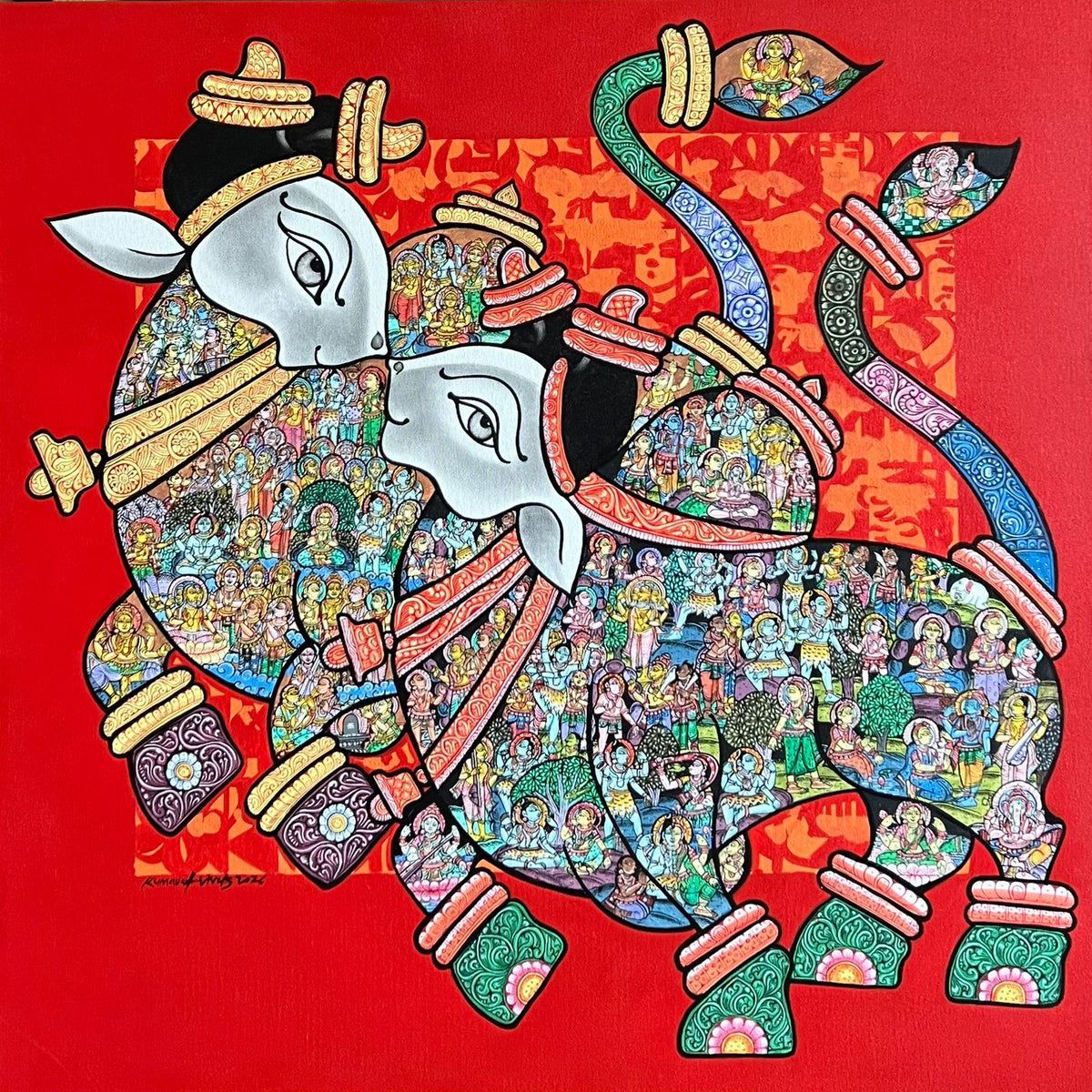
4. Douglas John: The Desert, Reimagined
Douglas John's landscapes stretch across the sparse, vast horizons of India's western desert — yet nothing about his palette is expected. Rather than rendering the desert in traditional sand tones, John paints it in embers of red, gold, and green, often layered with abstract patterning that adds depth and movement to the terrain.
His figures — young and old men walking the desert in white turbans and simple cotton attire — are instantly recognisable, grounding each composition in the lived rhythm of desert life while capturing its quiet magnificence.

5. Shri Kumar Adhikari: The Mughal Court Meets the Modern Day
Few artists collapse time as playfully as Shri Kumar Adhikari. His paintings place scenes from eras past — the grandeur of the Mughal darbar — alongside unmistakably modern-day details: selfies being taken, headphones, laptops. The effect is a seamless bridge between the 18th century and the present moment.
In The King and Queen's Court, royal attendants stand rigidly on guard around the monarchical couple, while a vibrant lineup of courtesans and courtiers fills the lower tier of the composition. Adhikari draws on his classical training to render striking architectural symmetry, fine zari embroidery, and the opulent textiles characteristic of 17th-century Mughal miniature painting — all while quietly needling the canvas with anachronisms that make it entirely of today.

6. Jiban Biswas: The Cool Cow
Jiban Biswas's cow doesn't stand quietly by the roadside, nor is it rendered in a traditionally revered pose. Instead, it appears in a thoroughly modern avatar — sipping coconut water through a straw, a shell necklace hanging from its neck, and a tie-dye red turban nodding to its Western Indian roots. The result is a piece that reads as both mischievous and calm, delighting anyone who encounters it.

Indian Paintings: Reinterpreted for Modern Spaces
What ties these six artists together isn't a shared style — it's a shared instinct: that heritage doesn't have to stay behind glass or in museums. Whether it's a galloping Nandi, a selfie-taking Mughal courtier, or a coconut-water-sipping cow, each artist proves that Indian paintings can honor its roots while speaking fluently to the present. For collectors — in India or across the diaspora — these works offer something rare: a piece of home that feels entirely, unmistakably now.
To view Artazzle's entire collection of exclusive and original Indian paintings that pay homage to the spirit of India on streets, its people and its landscapes, view the Artazzle collection Echoes of India.
Frequently Asked Questions
Q. Are these Indian Paintings shipped ready to hang?
A. Most Artazzle paintings are shipped rolled unless stated otherwise. For special requests to have works delivered framed, please get in touch with Artazzle Team. It can be facilitated at additional cost.
Q. What makes contemporary art different from traditional Indian art?
A. Indian heritage painting focuses on traditional, mythological, and regional themes (like Madhubani, Tanjore, or Miniature art) using natural pigments and established techniques passed down through generations. In contrast, contemporary painting breaks away from rigid traditional rules to emphasize modern concepts, individual expression, and experimental mediums. If you want a best of both worlds - choose a Contemporary Indian Heritage artwork which takes inspiration from traditional techniques ands ubjects — like Kalamkari, Mughal miniature, and folk painting — but applies them to modern subjects, colors, and themes, creating work that feels both rooted and current.
Q. What is Kalamkari painting?
A. Kalamkari is a hand-painted or block-printed textile and canvas art form from Andhra Pradesh, India, traditionally used to depict mythological narratives and epics using natural dyes.
Q: How should Indian diaspora collectors choose contemporary art for their homes?
A: Look for artwork that creates a personal bridge to your roots. Many collectors succeed by choosing pieces that blend nostalgic Indian motifs—like reimagined streetscapes, traditional symbols, or vibrant regional elements—with modern aesthetics that complement their contemporary living spaces.
Q. Are these paintings available for international shipping?
A. Yes all artworks are available for International shipping.


