Hyderabad's Art Voices: India's Most Collected Modern and Contemporary Artists

Hyderabad's Art Masters: The Painters Who Turned Village Life Into India's Most Collected Contemporary Art
Long before Indian art left a strong foortprint on global art scene, a handful of modern era artists working out of Hyderabad were already doing both — celebrating imperfect, everyday village life in bold color and unapologetic form. Today, their work anchors serious Indian art collections, and their visual language — rustic, sensuous, figurative, a little cheeky — is exactly the energy that pairs beautifully with contemporary spaces rooted in Indian heritage decor.
If you've been drawn to the Indian folk-rooted artworks in our own collection, these are the painters whose canvases tell the stories of native people of Telangana. Here's a quick, honest guide to Hyderabad's art masters — the senior legends and the contemporaries carrying the torch — worth knowing.
Why Hyderabad?
Hyderabad isn't usually the first city people associate with Indian modern art — Mumbai, Delhi, and Baroda tend to get that credit. But from the 1970s onward, a tight-knit group of artists trained at Hyderabad's College of Fine Arts and the University of Hyderabad built something distinct here: figurative, warm-toned, often sensuous work rooted in the region's own people — farmers, weavers, temple-goers, market women — instead of chasing Western abstraction or purely mythological subjects. It's a scene built as much on mentorship as on individual talent, with senior artists directly teaching, championing, and sharing studios with the next generation.
Thota Vaikuntam — The Colourist of Telangana
Born in 1942 in Boorugupalli, Andhra Pradesh, Thota Vaikuntam trained at the College of Fine Arts in Hyderabad before a Lalit Kala Akademi fellowship took him to Baroda, where he briefly experimented with abstraction under K.G. Subramanyan. He returned, instead, to what he knew best: the women of his village, their bright saris and heavy jewellery, rendered in flat planes of primary color. His first solo show was in 1973, and nearly fifty years on he's still the name most collectors mention first when Hyderabad's art scene comes up.

View artwork by Thota Vaikuntam → | More by Thota Vaikuntam →
K. Laxma Goud — The Senior Statesman
A contemporary of Vaikuntam and one of his early mentors at art school, K. Laxma Goud built his reputation on etchings and drawings before moving into painting, ceramics, and sculpture. His work is rustic and unmistakably sensuous — rural figures rendered with a directness that made him one of the most talked-about (and occasionally debated) artists of his generation. Today he's referred to simply as one of the "living legends" of the region, and rightly so — his influence runs through nearly every artist on this list.

Featured above is Laxma Goud artwork. Part of private collection.
Surya Prakash — The Mentor Who Built the Scene
If Thota Vaikuntam and Laxma Goud gave Hyderabad's art scene its faces, Surya Prakash (1940–2019) gave it its infrastructure. Born in Madhira, Telangana, he trained in Hyderabad and later studied under Ram Kumar in New Delhi before returning home to share a converted-garage studio with Laxma Goud and fellow artist Dakoji Devaraj — at a time when Hyderabad had almost no galleries and even fewer buyers. Rather than wait for the scene to arrive, Prakash organized the camps, exhibitions, and juries that built it, and became an early champion who helped push Thota Vaikuntam's work into major shows. His own painting moved between impressionist-influenced nature studies and freer abstract expressionism — a body of work later compiled into a retrospective titled Abstract Reality. He remains as important for who he brought together as for what he painted.
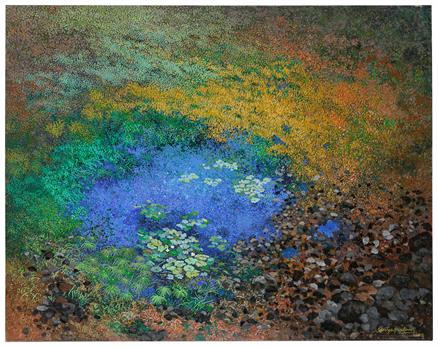
Artwork Image Source: StoryLtd. View details here.
Fawad Tamkanat — The Cityscape Storyteller
Born in Hyderabad in 1962 to the Urdu poet Shaz Tamkanat, Fawad Tamkanat studied under Laxma Goud at the University of Hyderabad and has spent decades reinventing his own visual language — from monochrome studies to his best-known cityscapes, where narrow lanes, stairwells, and domed clock towers twist across the canvas in earthy reds, deep blues, and electric turquoise. He's a gold medallist in both his BFA and MFA, and his cities feel less like documentation and more like memory — which is probably why they travel so well internationally, from New Delhi's National Gallery of Modern Art to collections in Denmark and Italy.
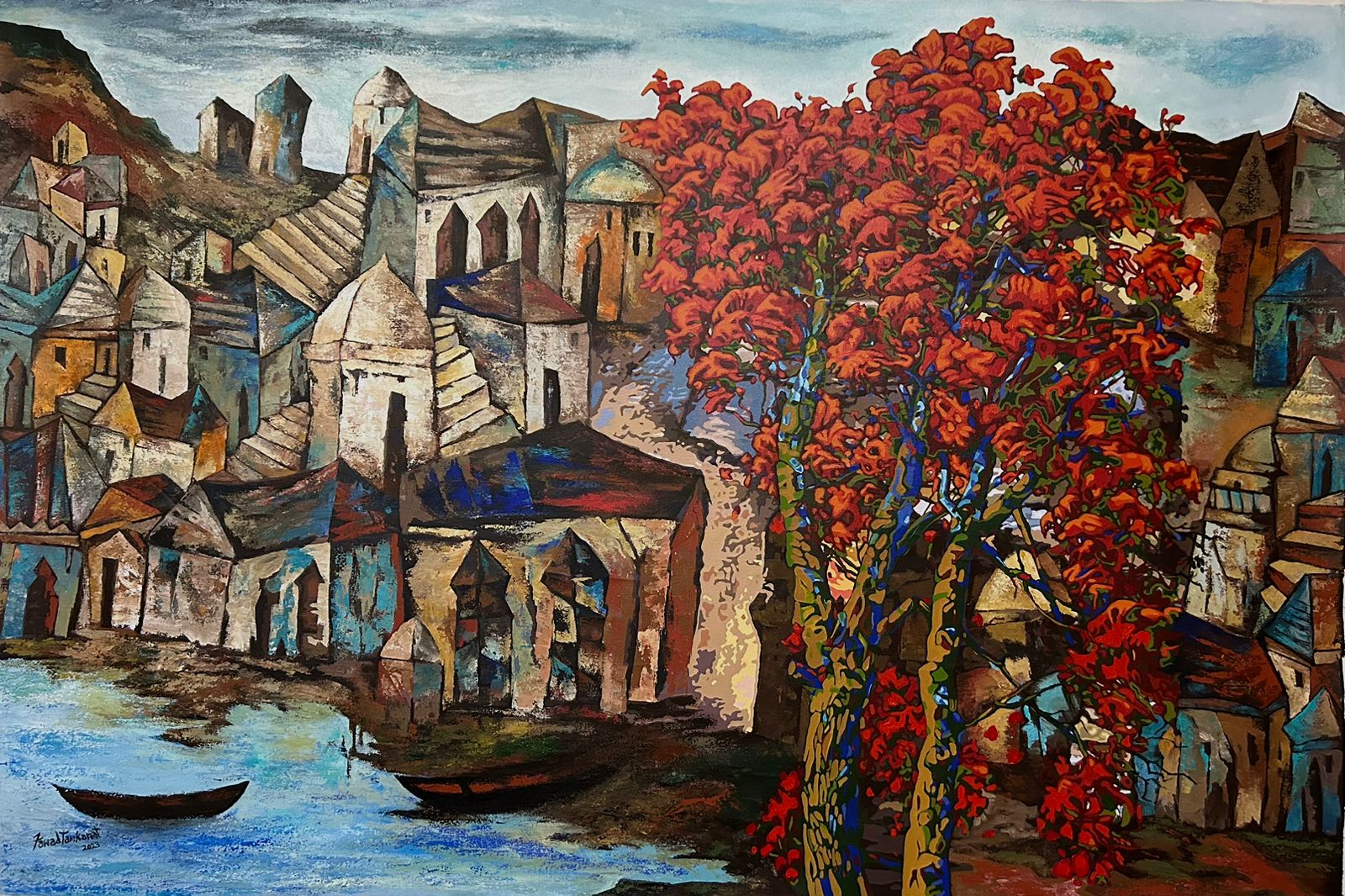
View artwork by Fawad Tamkanat → | More by Fawad Tamkanat →
Laxman Aelay — Telangana's Identity Painter
Laxman Aelay's path to the canvas ran through a signboard workshop, not an easel. Born in 1965 in Kadirenigudem, Nalgonda district in a Ikkat Weavers family, he started out painting shop signs, then film posters, before earning a fine arts degree and turning fully to painting. His early work from 'Song of the Village' series leaned into stark monochrome — black, white, and grey against blocks of red, green, or ochre — before shifting toward the richer, more celebratory color he's known for now. Aelay has been candid that for him, painting rural and Dalit life isn't just about culture; it's about identity and dignity. He also designed the official emblem of Telangana state in 2014 — a rare instance of an artist's visual language becoming a state's own.

View artwork by Laxman Aelay → | More by Laxman Aelay →
The Contemporaries Carrying It Forward
Ramesh Gorjala
Born in 1979 in Srikalahasti, Andhra Pradesh — a town known for its centuries-old Kalamkari textile tradition — Ramesh Gorjala grew up in a family of weavers and learned Kalamkari as a child from his uncle, a national award-winning practitioner of the craft. He's not a Hyderabad native, but Hyderabad shaped him as an artist: he earned both his BFA and MFA in painting from Jawaharlal Nehru Technological University, Hyderabad, and it's where his career as a painter properly began. Gorjala's mythological subjects — Vishnu, Krishna, Hanuman — are rendered in the earthy reds, greens, and gold of Kalamkari tradition, updated with modern touches like checkerboard-patterned backgrounds and fragments of text. His work reads as devotional and contemporary at once.
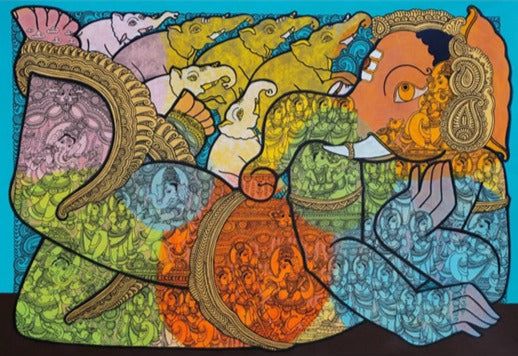
View Ganesha painting by Ramesh Gorjala → | More by Ramesh Gorjala →
Sachin Jaltare
Hailing from a small town in Maharashtra, Sachin Jaltare couldn't afford further education after graduating top of his class in applied arts from Nagpur University, and instead took a job as an illustrator at a Hyderabad advertising agency in 1991. He eventually left that job to paint full-time — a risk that paid off with support from senior Hyderabad artists including Laxma Goud and Vaikuntam themselves. Starting from figurative work, Jaltare's practice has moved toward abstraction built around Shiva-Shakti themes — form and formlessness, energy and desire, the mortal and the divine — rendered in a minimalist, geometric visual language with soft color gradation. He's lived and worked in Hyderabad since, with his work selected for the Benetton Art Book in 2010 and shown internationally.

View Sachin Jaltare's couple painting Shiv and Shakti→ | More by Sachin Jaltare →
What ties these artists together — beyond geography — is a refusal to idealize. Their subjects are ordinary people and familiar deities rendered with real presence: a woman with a child, celebration of the Poolama festival, the heritage architecture of lanes of Hyderabad, Lord Krishna's life narrated in detailed visuals a flute playing man caught mid-note.
Browse our exclusive fine art paintings collection to see the local narrations take form on canvas by established and senior Indian artists.


